
According to the latest safe work Australia report on mesothelioma, living in a fibro house built between 1947 and 1987 can cause an aggressive cancer (called mesothelioma) as a result of exposure to asbestos fibres.
In this article, we examine the report and the conveyancing practice for the sale of fibro houses (houses made with sheets of asbestos fibres mixed with cement).
Mesothelioma in Australia (report published August 2025)
The main findings in the report are:
- 684 cases of mesothelioma were reported to the Australian Mesothelioma Registry in 2024
- The number of cases diagnosed each year for both men and women has steadily increased over the past 40 years – the current incidence is around 3.0 cases per 100,000 population
- In 2023, 688 deaths of people from mesothelioma were recorded
- More than 9 in 10 people who had been diagnosed with mesothelioma were assessed as having a history of possible or probable exposure to asbestos
The report contains this information:
- Mesothelioma is a rare and aggressive cancer which can take many years to develop after being exposed to asbestos. It has a very low survival rate compared to other cancers because it is not curable.
- Asbestos is a group of naturally occurring fibrous silicate materials with fibres invisible to the naked eye that can be inhaled into the lungs where they do not readily break down.
- Asbestos was primarily used in the construction and transport industries because it was durable and resistant to fire and chemicals.
- Asbestos has been totally banned in Australia since December 2003. However, large amounts of asbestos-containing materials remain in older structures, including houses and strata units built before 1987.
The report contains information derived from a voluntary asbestos exposure assessment carried out by Safe Work Australia:
1,409 participants were assessed. Of these, 11.1% had occupational exposure only, 37% had non-occupational exposure only, and 51.9% had both occupational and non-occupational exposure.
- Most occupational asbestos exposure was in the building trades, especially the electrical trades (825) and in the Water transport and Land transport sectors (335).
- The non-occupational asbestos exposure was ‘possible or probable’ in most cases where there was occupational exposure, so some participants are counted in more than one category.
The participants with non-occupational asbestos exposure were reported as having -
- undertaken major home renovations that involved asbestos products (excluding paid work) (51% assessed as possible or probable exposure)
- lived in a house undergoing renovations (38% assessed as possible or probable exposure)
- serviced car brakes/clutch (excluding paid work) (29% assessed as possible or probable exposure)
- lived in the same home as someone with a job where they were exposed to asbestos and who came home dusty (21% assessed as possible or probable exposure)
- lived in a house made of fibro that was built between 1947 and 1987 (13% assessed as possible or probable exposure).
Living in a fibro house was significant enough to be listed, but undertaking renovations in a fibro house is much more significant.
We now turn to examine how the presence of asbestos is treated in the sale of residential property
Asbestos warnings in the Contract for Sale
In property conveyancing the focus has been to provide an asbestos warning to purchasers of residential property in the Contract for Sale.
In New South Wales, the standard Contract for Sale contains a warning about loose-fill asbestos insulation. This warning is given because in the 1960s and 1970s a company known as Mr Fluffy used raw amosite and crocidolite asbestos, known as loose-fill asbestos, as ceiling insulation in 71,000 homes in NSW.
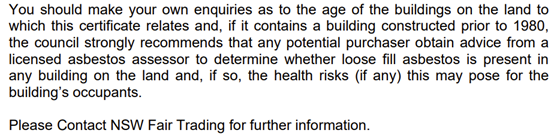
It recommends that for residential premises built before 1985, purchasers search the register kept by NSW Fair Trading and ask the local council to find out if it holds records that the property contains loose-fill asbestos. The register is limited to loose-fill asbestos. It is not a register of fibro houses, unless those houses have loose-fill asbestos.
A disclosure document issued by the local council must be attached to the Contract for Sale. It is called a Planning Certificate and contains advice about loose-fill asbestos, such as this:
 |
In Victoria, Contracts for Sale contain a more general warning about asbestos in a disclosure document prepared by Consumer Affairs Victoria called a Due Diligence Checklist - What you need to know before buying a residential property:
|
Is the building safe to live in? Building laws are in place to ensure building safety. Professional building inspections can help you assess the property for electrical safety, possible illegal building work, adequate pool or spa fencing and the presence of asbestos, termites, or other potential hazards. |
In the ACT, the vendor must attach to the Contract a Current Asbestos Assessment Report, if available, and if not, an Asbestos Advice Fact Sheet. This is an extract from the ACT Asbestos Advice Fact Sheet: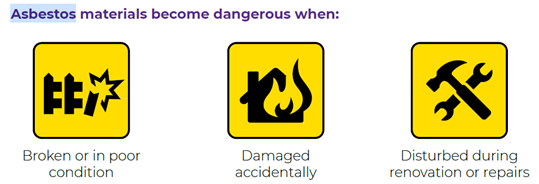
Extract from ACT Asbestos Advice Fact Sheet
Building Inspection Report disclaimers
Obtaining a pre-purchase Building Inspection Report is normal due diligence for purchasers of residential properties. In NSW, many real estate agents make Building and Pest Inspection Reports available to prospective purchasers.
But a pre-purchase Building Inspection Report does not report upon asbestos. They contain a disclaimer that the report excludes asbestos-containing material. For example:
THIS IS NOT an Asbestos Survey & Sampling Report. There are potential products in the property containing asbestos that will not be identified in this report. In order to accurately identify asbestos, we recommend performing an asbestos inspection, particularly for buildings built prior to 1988.
Strata Inspection reports for home units contain a similar disclaimer. For example:
This report does not consider the possible locations, affects, risks or otherwise general reporting of the presence of asbestos within the property.
What is the risk that the property contains asbestos?
This advice is taken from the NSW Government webpage – Asbestos in NSW
If you own or live in a rental property in NSW built before 1990, it may contain asbestos.
Exposure to asbestos fibres can lead to serious health conditions, but asbestos can be managed safely.
In most properties, non-friable asbestos is contained in materials like cement sheeting and is low risk if it’s undamaged. Damaged or loose material can become friable asbestos. This must be removed as it is a serious health risk, but asbestos can be managed safely.
Asbestos-containing materials are found both inside and outside older homes, terraces and unit blocks. Asbestos is often found in:
- roofing
- ceilings
- external and internal wall cladding
- eaves
- fencing
- flue and water pipes
You can’t tell if a material contains asbestos just by looking at it. Testing for asbestos by a licensed laboratory is the only way to know for sure. If you think it might be asbestos, play it safe and treat it like it is.
Conclusions
The safe work Australia report makes clear that living in a fibro house built between 1947 and 1987 constitutes a risk of harm for mesothelioma. That risk is magnified if any renovation work is carried out.
When buying a fibro house built between 1947 and 1987, a Building Inspection Report cannot be relied on for asbestos safety because the disclaimer it contains.
If it is a fibro house, the building materials must be tested by a Licensed Asbestos Assessor, and the asbestos must be removed safely before renovations are carried out.