
Off-street carparks are a legally required to have speed humps to ensure the safety of drivers and pedestrians.
But while speed humps protect pedestrians from collision by lowering car speeds, are speed humps a tripping hazard for pedestrians?
In a significant decision, the Court of Appeal of the Supreme Court of New South Wales held that a strata scheme was negligent when a pedestrian who was walking to their car tripped on a speed hump, fell on the concrete driveway and was injured. She suffered a broken right humerus (the upper arm bone near the shoulder). The Court awarded $250,499.06.
The decision is The Owners – Strata Plan No 31337 v Balacco [2026] NSWCA 50 (Leeming JA, Ward P and Free JA agreeing) (09 April 2026)
This is an analysis of the decision.
The facts
Shortly before 5:15 pm on 18 May 2023, Ms Grace Balacco finished work as a medical receptionist on level 4. She took the lift down to the level 2 carpark and started walking towards her car which was parked on level 2, when she tripped on a speed hump.
Her evidence was:
‘I was walking normal towards my car and then all of a sudden because not painted, it’s just concrete, it’s late, dark-ish. I just tripped over the speed hump and just went flying and yeah so.”
She marked in red on Exhibit 1 (photo 1 below) where she walked, where she tripped on the speed hump and where her car was parked. The photo was taken a short time after she fell. Note that the concrete speed hump is unpainted – it is the same colour as the concrete surface of the driveway. Note also that the concrete columns adjoining each parking space are painted yellow near their base.
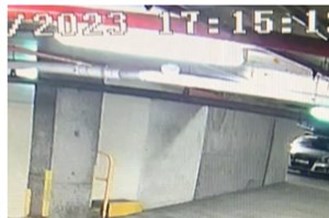
A view of the area between the lift well and Ms Balacco’s parking space is shown in photo 2 (below). The view is from a CCTV camera, which unfortunately was not pointed in the direction of the fall. It shows a rail and step painted yellow.
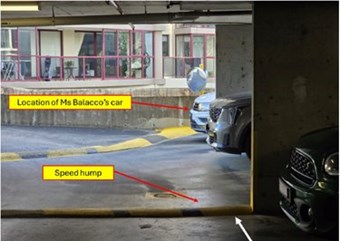
After the fall, the owners corporation of the strata scheme placed an order for marking in yellow and black bands the speed humps and the columns and other surfaces in the carpark in yellow. The total cost was $2,900 for labour and $500 for materials/paint, plus GST.
The speed humps were painted as shown in photo 3 (below).
The strata building was built in around 1987. The evidence was that the speed hump was in place since the building was built. According to the strata scheme, it had never been painted. The maximum height of the speed hump was 65 mm and the width was around 270 mm, which complied with the applicable standards at the time.
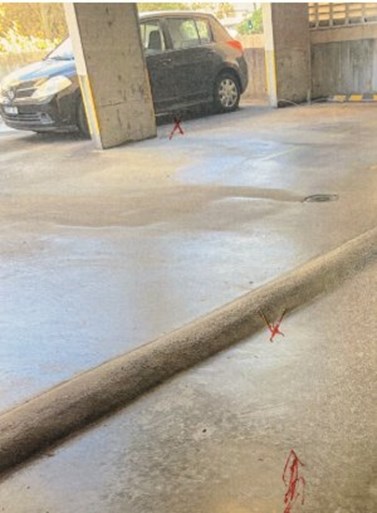 Photo 1 Speed hump in level 2 carpark where Ms Balacco tripped marked in red with path of travel, place of trip, and place where her car was parked. |
* All photos are taken from the judgment |
Was the strata scheme negligent (in breach of its duty of care)?
The strata scheme is under a duty of care is to exercise reasonable care and skill to prevent injury or other harm to others. The standard of care is to take the precautions a reasonable person would take against a risk of harm for foreseeable risks. (ss 5 & 5B Civil Liability Act 2002 (NSW)).
Ms Balacco said that strata scheme was negligent in that it had failed to take reasonable precautions to protect her against the risk of injury, namely “tripping and falling on the subject unpainted concrete speed hump”.
She said that the strata scheme had failed to take two reasonable precautions:
- To ensure that the lighting over the speed hump was adequate
It was shortly after sunset. The carpark lighting was on “sensor mode”. When motion was detected, it would turn up the lighting from 30% to 100%, The motion-detecting sensor was described as a “very good” system. The system was operating properly. There was a light above the centre of the speed hump (see photo 3).
The Court found that the carpark was “fully illuminated” (at 100% sensor mode) at the time of the accident. That is, although not “brightly lit”, the lighting “was acceptable and within standard”.
The Australian Standard is AS/NZS 1680.2.1:2008 Interior and workplace lighting, Part 2.1. A minimum of 40 lux is recommended and not less than 20 lux for safe movement in an underground carpark. At around the time the accident occurred, the light at the centre of the speed hump was measured at around 95-96 lux, at the edge closest to Ms Balacco’s vehicle it was around 41-44 lux, and at the far edge it was around 29-33 lux.
As a result, the Court found that the carpark was adequately lit and that the strata scheme had taken reasonable precautions (in terms of lighting) against the risk of harm.
- To paint the speed hump
The strata scheme said that a reasonable person would not have taken the precaution of painting the speed hump because the risk of harm was very low.
Ms Balacco said that the speed hump was a hazard. She said she was less likely to have slipped and fallen had the speed hump been painted yellow.
The Court agreed with Ms Balacco:
“Carparks are hazardous places. The design of this carpark forced pedestrians to share the same path as vehicles. ... The speed humps presented a readily foreseeable risk of tripping. The risk of harm from falling onto a hard concrete surface was plainly not insignificant. The likely seriousness of the harm was moderate. The burden of painting this potential hazard yellow, no differently from the dozens or hundreds of other obstacles in the carpark, was trivial. Doing so would also enhance the effectiveness of the speed hump as a measure to slow traffic ascending and descending the nearby ramp.”
“I conclude that a reasonable person would take precautions against the risk by painting both speed humps yellow, … the same … as all the other irregular surfaces and obstacles in the carpark.”
Accordingly, the strata scheme had not taken reasonable precautions against the risk of harm.
There was no contributory negligence on the part of Ms Balacco: she did not have the car keys in her hand as she approached the car and was wearing short boots with no heels.
Was the unmarked speed hump an “obvious risk”?
The strata scheme argued that the risk of injury by tripping on the speed hump was an “obvious risk”, despite the fact that it was not painted. If so, it was protected from a breach of its duty of care by ss 5F, 5G and 5H of the Civil Liability Act 2002 (NSW).
The Court found that the unpainted speed humps were not “obvious risks” because “every irregularity in the concrete surface underfoot” – the four concrete columns near the speed humps, the rise (the steps) in the concrete to get to and from the lifts, and the wheel stops at the rear of the parking spaces were “painted yellow, except the two speed humps”.
“Common sense would suggest that a pedestrian’s attention would more readily be drawn to the painted areas; potentially diverting attention from unpainted areas.”
The Court said that fact that Ms Balacco had driven over the speed hump before parking her car, had driven over the other speed hump two times to park her car, and had walked over the speed hump when leaving her car, did not make the risk presented by it one that was obvious.
The Court gave three reasons:
“One reason is that the issue is objective, and must apply to the first-time user and the tenant who has parked her car in the same place for months or years.
Another is that the myriad of impressions received by a person each day are readily forgotten, hence the utility of visual cues.
A third is that a person parking in the spot who drove over the speed hump would have been concentrating on the position of the vehicle, and any others, as he or she navigated in reverse into the spot, rather than the speed humps.”
The Court added “The fact that it [the speed hump] was lit and was large enough to be noticeable as it was driven over, does not stand in the way of this conclusion.”
The damages award
Ms Balacco was an experienced medical receptionist, aged 67 at the time of the hearing. After the accident, she took sick leave, and returned to work in July.
The trial judge awarded $385,484.78 for damages (compensation).
The strata scheme did not challenge the component awarded for ongoing pain and medical expenses. The strata scheme challenged the sum of $75,000 + $10,500 for superannuation for future economic loss and $49,485.70 for future domestic assistance.
The Court noted that “she was ready, willing and able to work full-time” and “that her age – substantially past the retirement age – might make it harder to obtain full-time employment, but that is a consequence of her age, not the accident itself.”
The Court of Appeal reduced that amount by $134,985.70 to $250,499.06 by reducing the amounts awarded for future economic loss (loss of earnings) (including superannuation) and future domestic assistance.
End notes
Australian Standard AS/NZS 2890.1 Parking Facilities
Australian Standard AS/NZS 2890.1 makes speed humps a legal requirement in off-street carparks for safety of pedestrians. Some of the specifications are:
- Speed humps must feature markings of alternating yellow or white reflecting stripes, typically 250 mm wide.
- The maximum height is in the range of 25 to 75 mm.
- Speed humps are placed no less than 10 metres apart and up to 50 metres apart.
- Speed humps should be located clear of intersections and tight corners.
- At least one metre of space is required beside a speed hump for pedestrian or wheelchair accessibility.
- Clear signage is required on maximum speed, location of exits, flow of traffic.
Compliance & Safety as an AGM Agenda item
Unlike the item to consider the annual fire safety statement which must be included in the agenda for the Annual General Meeting of the owners in a strata scheme, the inclusion of an item for Compliance & Safety is not compulsory.
Most AGM agendas do have a Compliance & Safety item such like this:
That the Owners Corporation acknowledge the Work Health and Safety Act 2011 and Regulations and resolve to authorise … to engage a consultant to update or prepare a Safety Report for the common property.
There was no evidence that a Safety Report had been prepared for the carpark in this case.
Increased Insurance premiums
A personal injury claim causes financial harm to the strata scheme.
In this case, the amount awarded and the legal costs, was paid by the strata insurer under the public liability cover in the strata insurance.
But over time, the strata scheme will pay for the claim. The policy will be labelled an underperforming policy and the future premiums will be increased be based on ratings factors and weightings applied by the insurer for the claim.
Changing strata insurers will not change the claims history.
For more click