
One Central Park is famous for its environmentally sustainable design. Visually, it is striking – the hanging gardens make the façade look like a green wall more than 100 metres high.
The building has two high-rise residential apartment towers with terraces and a heliostat, and a multi-level shopping centre and restaurants at the base of the towers.
Located on Broadway in the Sydney suburb of Chippendale, it was completed in 2013.
One Central Park was voted the 2014 Winner of the Best Tall Building Worldwide by the Council on Tall Buildings and Urban Habitat (CTBUH) based at Chicago’s Illinois Institute of Technology.
In the citation to the award, the building was described as: “an innovative and environmentally ambitious landmark project” with “the highest standards of sustainable residential design under the Australian Green Star rating system”.
The hanging gardens (also called vertical gardens) are integral to sustainability: “Thermal impact of sunlight on the building is reduced by up to 30 percent because of the presence of greenery, which of course traps carbon dioxide and emits oxygen as well”.
See the CTBUKH Webpage.
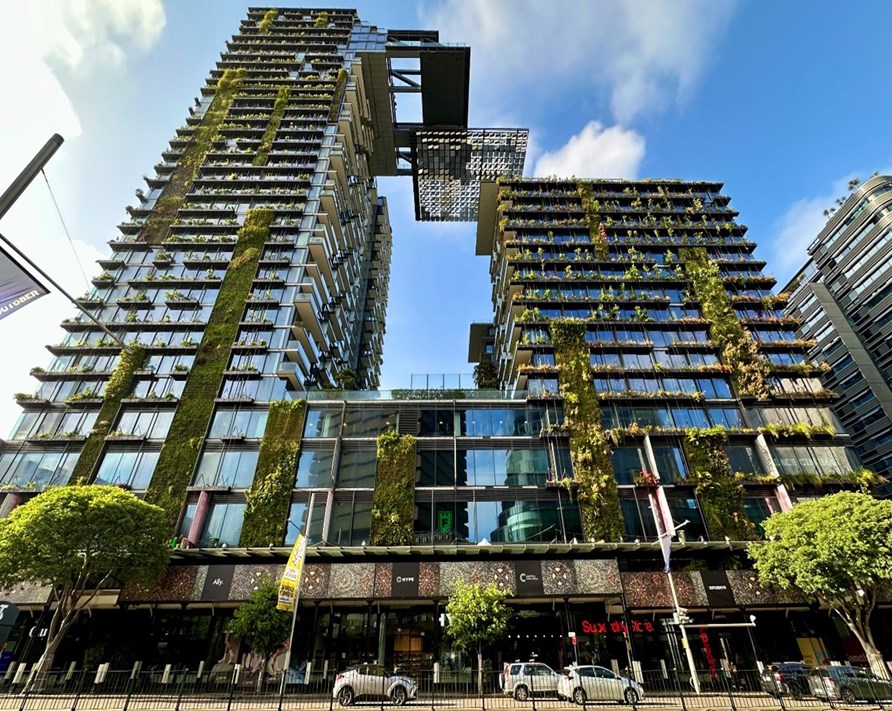 One Central Park with its distinctive hanging gardens on the Broadway façade © Copyright |
The hanging gardens on the façade grow from defective planter boxes.
The planter boxes are described in this way in a decision of the Supreme Court of New South Wales given on 10 October 2025 (the Building Defects Decision):
A distinctive design feature of the development is that the towers have vertical gardens, achieved by some 1,672 planter boxes cantilevered off the building façade.
The cantilevered planter boxes were made of a black moulded polymer box with irrigation and drainage elements. The planter boxes were clad in aluminium composite panels.
The planter boxes were attached to the buildings’ concrete edge beams by a bracket. Specifically, channels were cast into the face of the concrete slab. A bracket was bolted into the channel using a stainless steel T-bolt.
In April 2022, a planter box detached from the façade of level 29, fell and landed on the footpath. Afterwards, during routine vegetation maintenance and glass cleaning, abseil contractors noticed other planter boxes had “slipped”; because the heads of the bolts fixing the planter boxes to the building had broken off. Investigations later indicated that a bad batch of bolts was used to affix the cantilever planter boxes to the building.
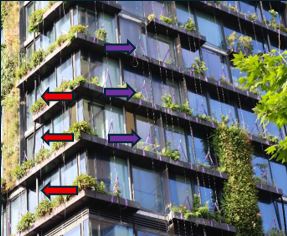
The planter boxes which had ‘slipped’ were emptied of plants and soil and removed from the façade. After giving an undertaking to Building Commission NSW, the Owners Corporation engaged Tradies on Ropes in December 2022 who secured the cantilevered planter boxes to the building by strapping them with ropes tied to the top of the building.
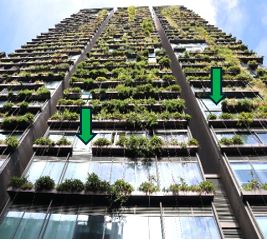
By March 2023, the installation of the rope support system was complete. Some 140 planter boxes were removed as it was not possible to attach the rope support system to these boxes. In total, 269 planter boxes have been removed.
Since March 2023, Tradies on Ropes has conducted routine and check-ups by abseil on the buildings about seven times a month.
*The Owners Strata Plan No 87881 v Frasers Broadway Pty Ltd [2025] NSWSC 1073
(10 October 2025) (Her Honour Justice Rees)
|
East Face One Central Park – hanging gardenWhere planter boxes were removed is indicated by green arrows © Copyright |
North and East Faces One Central Park - planter boxes. The planter boxes are strapped in by ropes - see purple arrows and the drainage pipes by red arrows © Copyright |
The Fire Safety Order
The planter boxes are clad with Aluminium Composite Panels (ACPs). This is a fire safety risk.
The Commissioner of Fair Trading issued a Building Product Use Ban on 10 August 2018 to prohibit the use of ACPs with a core comprised of greater than 30 percent polyethylene by mass in any external cladding, in residential apartment buildings.
The ACPs which formed the eternal cladding on the planter boxes have more than 30 percent polyethylene and so the cladding was banned panels. The Commissioner identified the building as an affected building.
After discussion with the affected parties, the Minister for Planning issued a Notice of Intention to Give a Development Control Order – Fire Safety Order on 9 March 2022.
After discussions, the Minister for Planning issued the Orders on 10 January 2023.
The Owners Corporations of the Strata Schemes and the retail manager (Fortius) applied to the Land and Environment Court of New South Wales to modify the Order.
The Court approved Modified Orders on 12 November 2024. They provided:
- Remove the ACPs identified in the combustible cladding assessment report
- Install replacement panels using the existing colour scheme and compliant with the Building Code of Australia
- Remove and replace parts of the green wall and implement maintenance measures
- Install fire sprinklers and replace the polymer planter boxes identified as combustible
- Complete the work by 28 April 2026
Fortius Broadway No 1 Pty Ltd v Minister for Planning; The Owners – Strata Plan No 87881 v Minister for Planning; The Owners - Strata Plan No 88765 v Minister for Planning; The Owners - Strata Plan No 89269 v Minister for Planning [2024] NSWLEC 1730
(12 November 2024) (Commissioner Targett)
The Building Defects Orders
The planter boxes are made with combustible material and are affixed to the façade with defective bolts. The drainage system for the planter boxes was also defective / not ft for purpose.
As a result of a change in the Building Code of Australia in 2022, the planter boxes no longer met the Deemed-to-Satisfy Provisions of the Code because they are made from combustible material.
An Alternative Solution regime remains a possibility, but performance tests need to be conducted to ensure compliance with the Performance Requirements.
In December 2023, the Building Commission NSW issued an emergency building work rectification order to the Developers. The serious defect described in the order was:
“A batch of the Type 2 Stainless Steel T-Bolts randomly distributed across the building to secure planter boxes in the vertical gardens are defective with some fracturing and failing.”
After discussion, the order was revoked and the Commission issued a new building work rectification order to the Developers, to which a second serious defect was added:
“The ability of the planter boxes to drain both stormwater rainfall catchment and sub-surface water flows effectively to the stormwater drainage system is defective.”
The drainage system is defective because it becomes blocked and causes the planter boxes to fill with water and overflow onto the building façade, causing damage and contributing to the planter boxes detaching and falling from the building.
The Owners have an estimate of cost of fixing the planter boxes which ranges between $24 million and $37 million, depending on the method undertaken.
The Building Defects dispute in the Supreme Court
The Owners are pressing for the more expensive method, which is to replace all the planter boxes with new. They say that the planter boxes need to be re-designed (and replaced).
The Developer is pressing for the cheaper method which is to replace the cladding and the bolts, leaving the planter boxes in situ. The Developer is disputing that the planter boxes are combustible and also the stormwater drainage defect.
Both have expert reports which support their position: façade engineers, structural engineers, hydraulic engineers, town planners, image engineers and fire engineers.
With the deadline of 28 April 2026 to carry out the fire safety order works fast approaching, the Owners sought this declaration from the Court:
Declaration that any re-installation of the existing cantilevered planter boxes (CPBs) … in performing the work mandated by the modified building work rectification order dated 16 February 2024, following the removal of the existing CPBs from the Development, would be in contravention of section 22 of the Design and Building Practitioners Act 2020 (NSW) and, therefore, contrary to law.
On 10 October 2025, the Court determined that it should not exercise its discretion to grant the declaration. The fact that the expert reports were conflicting was a significant reason why the Court did not grant the declaration.
As a result, the Owners will be forced to fund the work themselves, unless they can obtain an extension of time to complete the works. Fortunately, there are a large number of lots across all three strata schemes – 643 in all – who can contribute to the cost.
The proceedings for recovery of a contribution to the cost from the Developer will continue, until settled or determined by the Court.
Postscript
In 2024, a hoarding was placed all around the One Central Park building, to protect pedestrians. The hoarding is likely to remain in place for a long time.
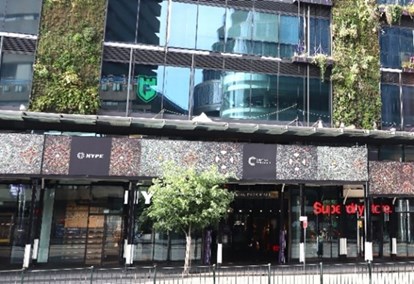 Hoarding over retail entrances and footpath – Broadway at One Central Park |
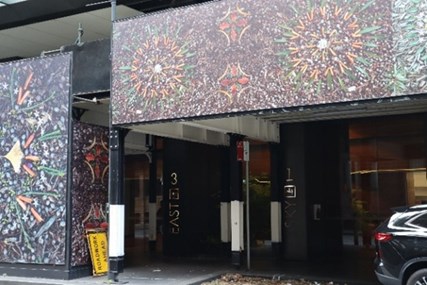 Hoarding over apartment entrances – Sky 1 and East 3 at One Central Park |