
The NSW Government balances two conflicting priorities. One priority is to promote the tourism economy by making short-term rental accommodation available to tourists and visitors. The other priority is to address the housing crisis by making long-term rental accommodation available to permanent residents.
On 1 November 2021, the NSW Government introduced a new regulatory framework for short-term rental accommodation to regulate the availability of housing stock for short-term rental accommodation. It introduced day caps in designated areas, fire safety standards, measures to reduce neighbourhood noise disturbances and bans for short-term rentals in strata schemes.
In 2024, the NSW Government reviewed the regulatory framework to find out how well it was ‘balancing benefits to the tourism economy with the potential costs for housing availability and affordability’. It also reviewed ‘potential options, including revenue measures, to encourage property investors to make homes available for long-term rental accommodation’.
This guide is for accommodation providers/hosts, managing agents, booking platforms and strata schemes. It covers:
- What is a short-term rental accommodation arrangement?
- Compliance requirements for short-term rental accommodation
- Day caps for short-term rental accommodation
- Bans for short-term rental accommodation in strata schemes
- The Short-Term Rental Accommodation (STRA) Register and Code of Conduct
- NSW Government review of short-term rental accommodation
A separate guide will cover taxation - Land Tax exemption for main residences, Capital Gains Tax treatment and Income Tax deductions for short-term rental accommodation.
What is a short-term rental accommodation arrangement?
The Fair Trading Act 1967 contains this description in section 54A:
|
Section 54A Fair Trading Act 1967 short-term rental accommodation arrangement means a commercial arrangement for giving a person the right to occupy residential premises for a period of not more than 3 months at any one time, … but does not include any arrangement prescribed by the regulations not to be a short-term rental accommodation arrangement. |
It is a commercial arrangement which means that it does not apply to friends and relatives who stay over unless they pay an occupation fee (more than a contribution to costs). And the arrangement is for not more than 3 months at any one time
The Residential Tenancies Act 2010 does not apply to short-term rental accommodation arrangements:
|
Section 8 Residential Tenancies Act 2010
|
For a residential tenancy the standard form Residential Tenancy Agreement contains the terms, and tenant protections are mandatory.
For a short-term rental there is no standard form agreement, and no tenant protections apply.
Can a short-term rental turn into a residential tenancy? The answer is yes – if a short-stay guest overstays for more than three months they automatically turn into a residential tenant.
If so, the terms of the standard form Residential Tenancy Agreement will automatically apply (even though none has been signed) and the accommodation arrangement is treated as a periodic agreement, with no specific end date. To terminate the arrangement, an owner must treat the guest the same as a residential tenant - give at least 90 days' written termination notice and provide a valid reason to terminate. The guest can dispute the termination in the tenancy tribunal (NCAT).
The accommodation must be residential premises
Short-term rentals and residential tenancies do have this in common: they are rights to occupy residential premises, as defined in the Residential Tenancies Act 2010:
|
residential premises means any premises or part of premises (including any land occupied with the premises) used or intended to be used as a residence. |
Residential premises are dwellings such as houses, home units and terraces.
Not all residential premises can be used for short-term rentals. The Fair Trading Regulation 2019 excludes these premises from being used for short-term rental accommodation:
- Tourist and visitor accommodation (which includes backpackers’ accommodation, hotel or motel accommodation and serviced apartments).
- a registrable boarding house
- a holiday park
- refuge or crisis accommodation
- disability accommodation
- temporary accommodation provided or funded wholly or partly by the Department of Communities and Justice.
Compliance requirements for short-term rental accommodation
The planning policy for short-term rental accommodation is found in the State Environmental Planning Policy (Housing) 2021 (NSW) (Housing SEPP).
Short-term rental accommodation is an exempt development which means that no Local Council approval/permit/consent is required to use a dwelling for this purpose, provided sections 111 and 112 of the Housing SEPP are observed.
|
111 Exempt development—hosted short-term rental accommodation Development for the purposes of hosted short-term rental accommodation is exempt development if the dwelling meets the general requirements. 112 Exempt development—non-hosted short-term rental accommodation (1) Development for the purpose of non-hosted short-term rental accommodation is exempt development for the purposes of this Policy if— (a) the dwelling meets the general requirements, and (b) for a dwelling located in a prescribed area—the dwelling is not used for non-hosted short-term rental accommodation for more than 180 days in a 365-day period, and (c) for a dwelling on land in the Byron Shire local government area other than excluded land—the dwelling is not used for non-hosted short-term rental accommodation for more than 60 days in a 365-day period. |
The prescribed areas are Greater Sydney Region, Ballina Shire, Muswellbrook and Clarence Valley (see below for details).
These are the general requirements (referred to) for a dwelling used for short-term rental accommodation according to Section 113 Housing SEPP:
- the dwelling must have been lawfully constructed as residential accommodation
- the dwelling must not be part of a building used for build-to-rent housing
- the dwelling is not used as a boarding house, co-living housing, a group home, a hostel, a rural workers’ dwelling, seniors housing, refuge or crisis accommodation, or a movable dwelling (i.e. cannot be a caravan)
- if the dwelling is in a building which must have a Fire Safety Certificate then a current certificate must be held for the building – this fire safety requirement applies to most multi-unit buildings and holiday units of 4+ units (without fire-separated walls)
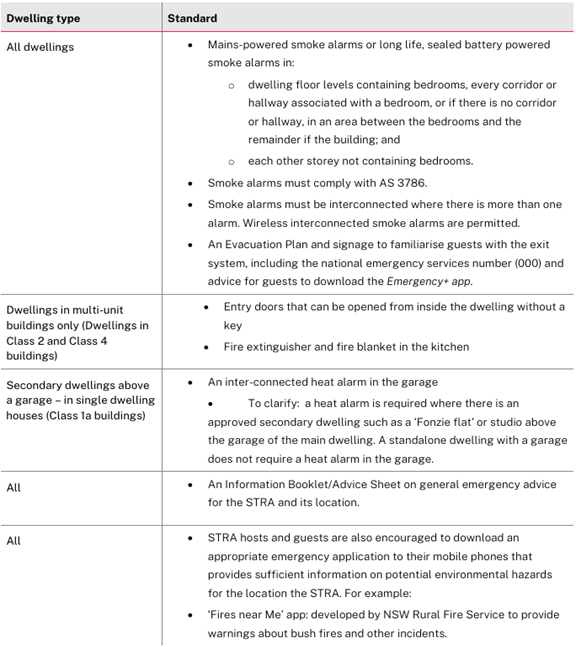
- the dwelling must meet fire safety standards such as having compliant smoke alarms and an evacuation plan and signage (see table below)
and:
- the dwelling must be registered on the NSW STRA Register
- the Code of Conduct must be observed
- where day caps apply, be used as non-hosted rental accommodation only within the day cap limits
Note: Planning Laws use the term dwelling while Tenancy Laws use the term residential premises. They are the same.
Fire Safety Standards are the main compliance requirement. ‘Smoke alarms are compulsory in all homes, apartments, rental properties, relocatable homes, caravans, moveable dwellings or any other residential building where people sleep’. (see Planning NSW webpage).
This table is from the NSW Government Frequently Asked Questions at p 9:
 |
The dwelling could be a detached house, a dual occupancy, a house and granny flat, a terrace house, a villa, shop top or an apartment in a residential flat building.
These definitions of host, hosted and non-hosted short-term rental accommodation are found in the definitions in section 110 Housing SEPP:
|
host means the owner, tenant or permanent resident of a dwelling who uses the dwelling to provide short-term rental accommodation. hosted short-term rental accommodation means short-term rental accommodation provided where the host resides on the premises during the provision of the accommodation. non-hosted short-term rental accommodation means short-term rental accommodation provided where the host does not reside on the premises during the provision of the accommodation. permanent resident of a dwelling means a person who permanently resides at the dwelling. short-term rental accommodation means a dwelling used by the host to provide accommodation in the dwelling on a commercial basis for a temporary or short-term period. tenant has the same meaning as in the Residential Tenancies Act 2010. |
The classification as an exempt development pathway is significant because it provides a low-cost entry into the tourist and visitor accommodation market to anyone with a dwelling.
The next level up is tourist and visitor accommodation for which Local Council approval / permit / consent is required.
There are many requirements to be satisfied to obtain Development Approval for tourist and visitor accommodation: Building Design and Site Layout, Environmental, Natural Hazards, Protection of Amenity, Access and Car Parking, Services and Advertising Signs and Structures.
The Standard Instrument (Local Environmental Plans) Order 2006) states five uses which are tourist and visitor accommodation, and three uses with separate requirements:
|
tourist and visitor accommodation means a building or place that provides temporary or short-term accommodation on a commercial basis, and includes any of the following— (a) backpackers’ accommodation, (b) bed and breakfast accommodation, (c) farm stay accommodation, (d) hotel or motel accommodation, (e) serviced apartments, but does not include— (f) camping grounds, or (g) caravan parks, or (h) eco-tourist facilities |
What is missing is an intermediate level to allow small providers to scale up to separately accommodate more than one group of guests. A suggestion is that more than one secondary dwelling (granny flat) be permitted, because secondary dwellings are an exempt planning pathway. Note secondary dwellings are limited in size to 60 square metres on residential lots of at least 450 square metres and are subject to setback and height rules.
Day caps for non-hosted short-term rental accommodation
Day caps are limits on the number of days short-term rental accommodation can be used per year.
Day caps are a significant part of the Housing SEPP policy to balance support short-term rental accommodation as a home-sharing activity and contributor to local economies, while managing the social and environmental impacts they have on reducing long-term rental accommodation and increasing rents.
In simple terms: day caps are used to limit short-term rental accommodation in tourist areas.
Day caps do not apply if the accommodation has Development Consent for use as short-term rental accommodation because the conditions of consent will outline Local Council policy.
Day caps apply to accommodation in these designated areas: Greater Sydney Region, in the Ballina area, in the Byron Shire, and in parts of the Clarence Valley and Muswellbrook.
The day caps are:
| Greater Sydney Region (this does not include the Central Coast, Blue Mountains or the Illawarra) | 180 days in a 365-day period |
| Ballina local government area | 180 days in a 365-day period |
| Byron Shire local government area (other than in the Byron Bay Town Centre and at Brunswick Heads) | 60 days in a 365-day period |
| Clarence Valley and Muswellbrook areas – town centres | 80 days in a 365-day period |
Day caps do not apply if the residential premises are the owner’s residence – that is, hosted. Most home stays - ‘renting spare room’ style, are hosted.
Day caps do apply if the residential premises are not the owner’s residence – that is, non-hosted. Most holiday rentals - houses and apartments in tourist locations are non-hosted.
The host is the owner, tenant or permanent resident of the residential premises. (see Section 110 Housing SEPP)
The host’s residency is the key:
If the host resides on the premises, it is hosted short-term rental accommodation and day caps do not apply.
If the host does not reside on the premises, it is non-hosted short-term rental accommodation and day caps do apply in the designated areas.
The standard proofs of residency are utility bills, council rates notices, driver licences, lease agreements, or home insurance policies addressed to the host at the residential premises. The number of days spent at the premises is not important.
Notes:
- A host who has a house in which they reside, and a granny flat which is used as short-term rental accommodation, can treat the granny flat as hosted short-term rental accommodation
- A holiday house or a unit separate from where the host resides is treated as non-hosted short-term rental accommodation
- For more see Department of Planning Frequently Asked Questions at p 3.
A 21-day exemption applies for non-hosted short-term rental accommodation bookings for a period of 21 consecutive days or more to the same person or persons or more. This means that these days do not count towards the day cap. This is Section 112(2) Housing SEPP:
| 2) In calculating the number of days a dwelling is used for non-hosted short-term rental accommodation, a period of 21 consecutive days or more during which non-hosted short-term rental accommodation is provided to the same person or persons must not be counted. |
Short-term rental accommodation bans in strata schemes
A strata scheme can pass a by-law to completely prohibit non-hosted short-term rental accommodation arrangements. The by-law needs to be passed by a special resolution at a general meeting where not more than 25% of the value of votes cast are against the resolution.
But a strata by-law cannot limit or prohibit hosted short-term rental accommodation arrangements.
Section 137A of the Strata Schemes Management Act 2015 sets out what the strata by-law may and may not prohibit:
|
137A Short-term rental accommodation (1) A by-law made by a special resolution of an owners corporation may prohibit a lot being used for the purposes of a short-term rental accommodation arrangement if the lot is not the principal place of residence of the person who, pursuant to the arrangement, is giving another person the right to occupy the lot. (2) A by-law has no force or effect to the extent to which it purports to prevent a lot being used for the purposes of a short-term rental accommodation arrangement if the lot is the principal place of residence of the person who, pursuant to the arrangement, is giving another person the right to occupy the lot. (3) In this section, short-term rental accommodation arrangement has the same meaning as in section 54A of the Fair Trading Act 1987. |
A sample strata by-law which complies with section 137A is:
|
BY-LAW - SHORT-TERM RENTAL ACCOMMODATION ARRANGEMENT DEFINITIONS & INTERPRETATION 1.1 In this by-law: (a) Environmental Planning Instrument means an instrument from time to time applicable to the Property, including without limitation any local environmental plan, development control plan, state or other environmental planning policy and any development consent condition. (b) Lot means a lot in strata scheme XX. (c) Owner or Occupier means the owner or occupier of a Lot from time to time. (d) Owners Corporation means the owners corporation created by the registration of strata plan registration no. XXX. (e) Property means the land and improvements comprising the parcel the subject of strata plan XXX. (f) Short-term Rental Accommodation Arrangement has the same meaning as in Section 54A of the Fair Trading Act 1987 (NSW) and Section 137A of the Strata Schemes Management Act 2015 (NSW). RESTRICTION OF SHORT-TERM RENTAL ACCOMMODATION ARRANGEMENTS 2.1 An Owner or Occupier of a Lot (“Host”) must not allow another person (“Guest”) to occupy the whole or any part of the Lot for a period (“Occupation Period”) if:
2.2 The Host must:
2.3 The Host must ensure that the Host and the Guest:
|
A strata by-law which prohibits hosted use of strata dwelling for short-term rental accommodation is invalid. The dwelling is hosted so long as the strata dwelling is the owner’s principal place of residence, although the owner may be absent at times.
If there is no strata by-law banning use as short-term rental accommodation, then the strata dwelling can be used as a non-hosted strata dwelling, subject to day caps applicable if it is in a designated area.
Some strata schemes have tried to restrict hosted short-term rental arrangements in their by-laws.
The strata scheme known as “Sky Residence” in Newcastle adopted a special by-law to require lot owners (1) to notify the Owners Corporation if they used their lot for short-term rental arrangements, (2) to pay a security bond of $1,000 and (3) to pay an administration fee consisting of “any reasonable administrative … costs” and “other costs and expenses for using the lot for a short-term rental accommodation arrangement”.
A lot owner challenged the validity of the by-law by making an application against the Owners Corporation in the Civil and Administrative Tribunal New South Wales (NCAT). Senior Member K Mortensen declared that the by-law was invalid under section 150(1) of the Strata Schemes Management Act 2015 because it “contains provisions that are unconscionable, and oppressive, specifically regarding the imposition of the Administrative Fee and the Bond” contrary to section 139(1) of the Act.
The decision is Nicholson v The Owners – Strata Plan No 104042 [2025] NSWCATCD 202 (8 December 2025)
This decision illustrates that strata-by-laws which do not strictly comply with Section 137 may be invalid.
The Short-Term Rental Accommodation (STRA) Register and Code of Conduct
The STRA Register
The STRA Register is a government register set up to ensure compliance with the new fire safety standards, as well as tracking day cap compliances for short-term rental accommodation (STRA) and provide details to assist Local Councils with monitoring STRA in their local government areas.
Owners of STRA must register their premises on the STRA Register via the NSW Planning Portal before they advertise or offer short-term rentals.
On registration, the owner is issued with an STRA property ID number, which must be displayed on the online property listing. Registration is renewable annually.
Online booking services cannot list a property for short-term rental unless there is a current registration.
The STRA Register will capture the number of days a dwelling is used for STRA and enable monitoring of compliance with day limits. This is facilitated through information shared by STRA booking platforms and the STRA Register.
If you or your letting agent self-manage bookings, booking arrangement information will need be entered directly into the STRA Register for each booking.
The personal information of the host or premises details are not available to the general public. This means that personal details on the ownership or STRA compliance status of a particular premises will not be provided to any person (including not to neighbours) on request.
Only short-term rental accommodation needs to be registered – tourist and visitor accommodation is not registered on the STRA Register.
The Code of Conduct
Division 4A of the Fair Trading Act 1987 (NSW) prescribes a Code of Conduct for the Short-term Rental Accommodation Industry. The Code is administered by NSW Fair Trading.
The Code applies to short-term rental accommodation industry participants, who are described as: providers of online booking services (booking platforms), booking agents, hosts, anyone who gives a right to occupy, and providers of property management services.
The aim of the Code is to establish behavioural obligations for short-term rental accommodation participants to ensure that “residential neighbours can enjoy the amenity of their homes without unreasonable disturbance”.
Observance of the Code is mandatory. Contravention is a criminal offence and can result in a monetary penalty. Contravention of the Code can also result in hosts being excluded and premises being excluded from the STRA Register. Guests can also be excluded. The NSW Government has a portal for the public to search for guests and hosts who are on the exclusion register.
This is a summary of the Code:
- Industry participants must act honestly and in good faith in relation to a short-term rental accommodation arrangement and to any dealing, complaint or dispute relating to a short-term rental accommodation arrangement.
- Booking platforms must inform the industry participant of the code and their obligation to comply with the code; must not advertise premises of an excluded host or excluded premises; must not enter into an accommodation arrangement for an excluded guest.
- Industry participants must notify the others when made aware of a dispute concerning a host, guest or premises.
- The premises must be registered on the premises register before being advertised and the registration number must be displayed on advertising.
- There is no licence requirement for a host to operate short-term rentals, but if the host / authorised representative carries on business or as an agent, then they must hold a real estate management licence.
- Hosts must hold insurance that covers their liability for third-party injuries and death.
- Hosts with short-term rentals in a strata scheme must notify the owners corporation and the occupants of residential premises directly neighbouring the premises that the host is using the premises for the purposes of offering short-term rental accommodation arrangements on the premises and provide the contact details of the host or an authorised representative.
- The industry participant must give the premises register operator information about each short-term accommodation arrangement.
- Industry participants must comply with a request made by the Commissioner to produce information relating to their activities as a short-term rental accommodation industry participant of this code.
- Industry participants must keep records for three (3) years.
NSW Government review of short-term rental accommodation
The NSW Government has undertaken a review of the regulatory framework for short-term rental accommodation (STRA) in NSW.
The NSW Government exhibited a Discussion Paper from 15 February to 14 March 2024 on the NSW Planning Portal.
The Discussion Paper contained this information:
- As of January 2024, there were approximately 52,300 dwellings registered for short-term rental accommodation across the state. About 33,000 of these were registered for non-hosted short-term rental accommodation.
- The focus of the government has shifted from addressing guest behaviour and neighbourhood amenity to the effects of short-term rental accommodation on the housing market and housing affordability.
The Discussion Paper summarises the benefits and disadvantages:
Benefits of short-term rentals - Tourists benefit from increased accommodation options, new travel destinations, greater flexibility and potentially greater cost-effectiveness compared to other forms of accommodation. Local businesses benefit from the increased demand for goods and services, which also supports the employment and wages of workers. Short-term rental accommodation near hospitals and medical centres, or near employment or education hubs, gives patients, their families, workers and students added accommodation availability.
Disadvantages of short-term rentals Dwellings that are not used for long-term purposes may contribute to higher housing costs by reducing the availability of long-term rental accommodation and the number of properties available to buy. This can lead to higher property prices and long-term rental costs.
The NSW Government has not announced any changes to the short-term rental accommodation policy framework.