
Tree roots damage walls, paths, fences and drainage lines. Tree roots grow unseen until a crack appears in a brick wall, a path becomes uneven, a fence starts to lean or a drainage line is blocked.
In this article we dig deep into the law of tree roots in New South Wales.
- What can be done when tree roots cause damage?
- Who decides if the tree is to be removed or the roots pruned?
- Who pays for the tree removal or root pruning?
- Who pays for the repair or replacement of the damaged wall, path, fence or drainage pipes?
We examine three situations chosen because the place where the tree is growing determines what law applies:
- If the tree is growing on your land, you obtain a tree works permit from the Local Council for tree removal or to prune tree roots, according to the Council's Guidelines.
- If the tree is growing on your neighbour’s land, you obtain a Court order from the Land & Environment Court to order the neighbour remove the tree or prune the roots, according to the Trees (Disputes between Neighbours) Act
- If the tree is growing on Public land, you obtain an order from a Civil Court to remove the tree, according to the civil law of private nuisance.
If the tree is growing on your land
The NSW Government Greener Neighbourhoods program is designed to increase the urban tree canopy and green spaces - to keep neighbourhoods ‘healthy, cool, and liveable’.
Currently Greater Sydney’s tree canopy is about 22 per cent, which is well short of the target of 40 per cent tree canopy cover. Local Councils have programs to increase street planting and to encourage private property owners to plant trees to increase tree canopy cover.
The detailed planning and design guidelines are found in the Local Council’s Development Control Plan – Preservation of Trees and Vegetation. This is the introduction to one plan:
‘Trees are a major influence on our streetscapes, contributing significantly to the appearance and value of properties. Indigenous trees provide shade for humans and structures, shelter for wildlife and in urban areas act as wildlife corridors. Trees reduce the effects of pollution, humidity, glare, soil erosion, improve water quality and are an essential part of our living environment.’
It’s no surprise that Local Councils make it difficult for trees to be removed. Local Councils are especially reluctant to approve removal of mature trees because they take a long time to grow and significantly contribute to tree canopy cover.
Local Councils require landowners to obtain a tree works permit to remove a tree and to prune branches or roots. Some Councils allow 10% to be pruned without a permit, others require a permit for all pruning.
A tree is subject to Council’s Development Control Plan if it has a canopy higher than a specified height above ground level – the height varies from Council to Council – for some it is 2.5 metres, for others, it is 3, 4, 5 or 6 metres. Trees below that height may need a permit if the trunk diameter at ground level is more than 300mm / 1 metre or the canopy spread is over 4 metres wide.
Local Councils assess tree works applications by tree species, tree location and tree health. Some tree species are ‘undesirable trees’, such as umbrella trees, willow trees, tree-of-heaven and Leyland Cypress. These species are exempt from a permit or approval to remove or prune. Other species are desirable, such as Indigenous / native Australian trees, heritage trees and trees in a heritage conservation area. These species are protected and will not be permitted to be removed or pruned, unless they are structurally unsound, in poor health, in decline or dead. Often a tree removal permit is made conditional upon the planting of a suitable replacement tree.
The Local Council Tree Officer will the assess the application. It will assist if you include an arborist’s report on the tree in the tree works application. The report will contain the arborist’s recommendation.
Some tree species are “renowned for having extensive root systems, which cause damage to footings of houses or, trees that may cause blockages to domestic sewer and drainage lines”. Tree works permits for removal are more likely to be issued for these tree species.
Councils will not permit tree removal if there are feasible alternatives to retain the tree, such as replacing terracotta drainage pipes with PVC pipes, re-lining the pipes or pruning the roots.
New buildings proposed near trees may be approved conditionally upon the tree rots being protected. In a recent development approval, the Inner West Council made it a condition that the footings of proposed townhouses to be of isolated pier or pier and beam construction to protect significant roots of a Camphor Laurel, a Bay Tree and a Chinese Celtis it wanted retained (see image).
If Council refuses the application, appeal lies to the Land & Environment Court.
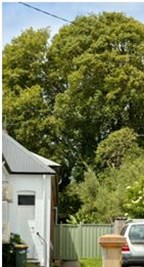 The roots of this tree are protected when building over the roots |
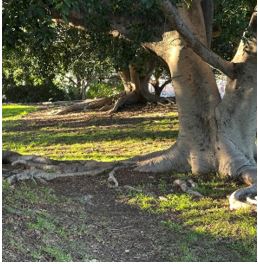 Port Jackson Figs with spreading root systems in a park. All images © Copyright |
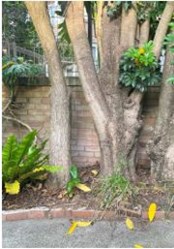 Umbrella Trees, next to a wall, removed after causing cracks in the neighbour’s wall |
If the tree is growing on your neighbour’s land
If your neighbour consents to your application for a tree works permit for their tree, then you can make the permit application with the Council.
If your neighbour refuses to consent, or if the Council refuses the application, you use the Trees (Disputes between Neighbours) Act 2006. The Trees Act applies to trees growing on urban / residential land but not on Crown land / Public land such as roads, parks, reserves, schools, hospitals, public housing.
Section 7 of the Trees Act gives the right to apply to the Land & Environment Court for a tree on a neighbour’s land:
An owner of land [the applicant] may apply to the Court for an order to remedy, restrain or prevent damage to property on the land, or to prevent injury to any person, as a consequence of a tree to which this Act applies that is situated on adjoining land [the neighbour’s land].
‘adjoining land’ means land with a common boundary or shares a corner with the land on which the tree is growing. The definition extends to trees across a public street or a public walkway, where the tree roots grow under and across that street or walkway. Trees straddling a boundary are said to be growing principally on the land of the neighbour with more than 50% of its stem area at ground level.
Section 10(2) of the Trees Act sets out when the Court will make an order:
(2) The Court must [be] satisfied that the tree concerned—
(a) has caused, is causing, or is likely in the near future to cause, damage to the applicant’s property,
Orders for removal can be made, as can orders for payment of damages (compensation).
Court Orders override refusals or other decisions made by the Local Council.
These case studies illustrate how the Court applies the Trees Act:
Have the tree roots caused, or are causing, or are likely in the near future to cause, damage to the property?
Cracks can appear in brick walls, paths can lift and fences can lean for many reasons. They could be built on clay which shrinks when it dries out, they could be poorly constructed or could become waterlogged through poor drainage. If tree roots are the cause of the damage, then the link between the tree roots and the damage must be demonstrated.
In Stevens v Russell & anor [2016] NSWLEC 1233 at [41], Commissioner Fakes noted “it is a common assumption that the mere presence or proximity of a tree is sufficient to conclude that the tree is the cause of the damage. It is not. It is necessary to find evidence to substantiate the assumption that the tree has caused the damage. In the case of alleged root damage, some excavation is usually required.”
Excavation will reveal if a tree root is touching a wall, is growing underneath a wall or a path or a fence post. In some cases, a root mapping report is neededl to determine the spread of the roots.
In Elder v Singleton [2025] NSWLEC 1761 at [12] Acting Commissioner Galwey noted “Tree roots may be present beneath the dwelling’s foundations, and may have contributed to movement, but compensation cannot be ordered on a mere possibility.”
The other purpose of excavation is to identify the tree from which the roots are growing. This is particularly useful for sewer and drainage line blockages if there are a number of trees nearby on different properties. The PlantClinic at the Botanic Gardens of Sydney provides DNA testing on tree roots to confirm the species.
Excavation was not necessary in Jackson v Cannon [2025] NSWLEC 1902 The tree was a mature cypress tree, in healthy condition. On the applicant’s side of the fence, the section of the paved pathway nearest the tree had lifted – it was a 20mm rise between the two sections of paving. Acting Commissioner Galway was satisfied the tree roots had contributed to the damage, and that the roots will cause further damage, and ordered removal of the tree. As to who pays, he said: “ordinarily in these proceedings the [neighbour] is ordered to arrange and pay for removal of their tree, and that is what will be ordered here.” He also ordered the neighbour pay $957 towards the cost of repair of the paving because of his delay in dealing with the tree.
A period of 12 months has been adopted as a rule-of-thumb to determine if no damage has taken place yet, but damage is ‘likely in the near future’: Yang v Scerri [2007] NSWLEC 592.
The Court has a wide discretion on the orders it makes. Section 12 of the Trees Act contains a list of matters to be taken into consideration. We focus on sub-sections 12(a) and 12(h) in the following illustrations:
Root pruning is not suitable for trees growing close to a wall
12(a) the location of the tree concerned in relation to the boundary of the land on which the tree is situated and any premises,
Illustration: Lovering v Bromage [2023] NSWLEC 1029 Acting Commissioner Douglas ordered removal of the tree. He noted “Given Tree 2’s close proximity to the boundary wall, this emerging wall damage is likely to increase relatively rapidly, and root pruning to provide clearance from the wall would necessarily be so severe that it would likely lead to destabilisation of the trees.”
Has the neighbour told the tree owner that the roots are causing (or likely to cause) damage?
After the link between the tree roots and the damage has been demonstrated, the Court must consider other matters before it orders compensation be paid to the neighbour for the damage caused. Sub-section 12(h) requires the Court to consider if:
- anything, other than the tree, has contributed, or is contributing, to any such damage including impact of any trees owned by the neighbour, and
- any steps taken by the neighbour or the tree owner to prevent or rectify any such damage,
The Court asks these questions:
- When did the tree first cause damage?
- What else contributed to the damage?
- What actions did the neighbour complaining take to prevent damage?
- When was the tree-owning neighbour made aware of the damage?
- What actions did the tree-owning neighbour take to prevent damage?
The liability of the tree-owner to pay compensation is limited to damage caused from the point in time when the neighbour suffering the damage has notified them of the damage. No compensation is payable for damage which pre-dates the notification. The notification must be more than a casual conversation. And preferably it needs to be accompanied by photos, a report, a quotation for repair, in writing / be email. And the neighbour can only be compensated for damage caused since they purchased their property.
Illustration: Fang v Li [2017] NSWLEC 1503 Acting Commissioner Galwey found that the neighbour’s Tulip Tree's roots had damaged Mr Fang’s path and pipes. But the damage existed when Mr Fang purchased the property and had not become worse since then by any action or lack of action by the neighbours. Therefore, Mr Fang had to pay for his repairs and for removal of the tree roots from his property, while the neighbours had to pay for removal of the tree.
Illustration: So v Turnbull [2021] NSWLEC 1424 Acting Commissioner Galwey found that the neighbour was not notified of the damage caused by an umbrella tree roots until 2020. In early 2021, the neighbour removed the tree (after obtaining Council consent). The Commissioner refused to compensate the applicant for the cost of a new path and front wall because the neighbour had taken reasonable action to prevent further damage by removing the tree once they became aware of the damage the roots was causing. The Commissioner rejected the applicant’s argument that the neighbour should be responsible because it is well-known that the roots of umbrella trees are invasive.
Illustration: Stanford v Hall [2012] NSWLEC 1217 Acting Commissioner Galwey found that the neighbours took no action from 2005 when they were notified (by way of a report) that the roots of their umbrella tree (which was approximately 9 metres high) was damaging the brick boundary wall until 2011 when the applicants again raised their concerns. During that time the wall had deteriorated so much that it could no longer be repaired. It needed to be replaced. The Court ordered that the neighbours remove the tree and pay for the cost of a replacement wall built to the same standard as the damaged wall because they had contributed to the damage through taking no action after becoming aware of the damage being done to the wall.
Tree roots and terracotta drainage pipes
Many claims are brought for the compensation for damage to old sewer and drainage pipes. This is an illustration of how the Court assesses such claims.
In Elder v Singleton [2025] NSWLEC 1761 at [12] Acting Commissioner Galwey was dealing with damage caused by roots from a weeping fig. He noted “Evidence before the Court does not demonstrate that the fig tree’s roots broke the pipe, only that they were found in the pipe. It is most likely that tree roots have entered via joints between terracotta and PVC sections, or cracks in the old terracotta pipe, before growing further within and blocking the pipe. Were the pipe in good condition, without cracks and the like, roots would be less likely to enter it. I find that other factors, such as the pipe’s condition, have contributed to the ability for tree roots to enter and damage the pipe.” He refused to order compensation of $37,000 for the cost to repair the pipe.
If the pipe is a PVC pipe which has been damaged by tree roots, the Court is likely to order compensation.
Root pruning does not necessarily involve a root barrier
In Gardiner v Austin [2022] NSWLEC 1417 Assistant Commissioner Douglas ordered the roots exposed along the side path between the house and the shared boundary be poisoned, and then the roots growing under the common boundary be severed on the neighbours side to a depth of at least 300mm below the soil surface. He did not order a root barrier to be installed.
Orders to repair damage to property
The Court may make orders to repair damage to property caused by tree roots. Examples are:
- Re-laying of paths or driveway
- Re-laying of courtyard paving
- Replacement or cleaning of sewer pipes
- Repair of retaining walls
- Repair of dwelling walls
- Repair or replacement of boundary fence
Case studies can be found in Tree Disputes – Tree roots causing damage
Legal costs are not awarded against the ‘loser’ in Trees Act cases (as a rule)
Court Rule 3.7(2) states:
The Court is not to make an order for the payment of costs unless the Court considers that the making of an order as to the whole or any part of the costs is fair and reasonable in the circumstances.
In Stroud and Anor v CMZZJ Investments Pty Ltd (No 2) [2025] NSWLEC 72 Justice Robson noted: “the “no discouragement” principle underlies the presumptive rule in r 3.7(2). Put simply, a person generally should not be discouraged from making or defending an application by the prospect of an adverse costs order.” In this case, he made no order for costs because there was no unreasonable conduct, and so it would not be fair and reasonable to make a costs order.
Trees can damage a building by lifting foundations or by absorbing moisture
The CSIRO resource – Foundation Maintenance and Footing Performance - contains useful information to assist in assessing the contribution of the tree to the damage to the foundation of a building. This is a summary:
- Most buildings suffering movement problems have clay soil foundations. Clay soils are reactive to moisture by swelling when saturated and shrinking when drying out.
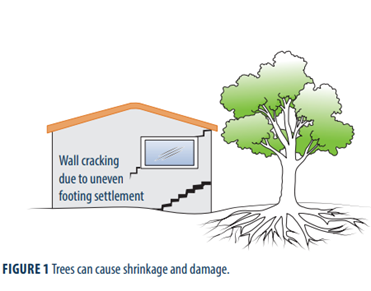
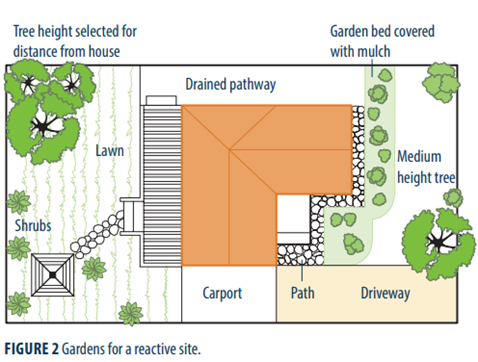
- Trees and shrubs that are allowed to grow in the vicinity of footings can cause foundation soil movement either by roots that grow underneath and cause upward pressure on footings or by absorbing moisture causing shrinkage which removes support from under footings resulting in subsidence – see Figure 1.
- It is usual to see brickwork cracking at weak points, such as openings for windows and doors.
- If the offending roots are subsidiary and their removal will not significantly damage the tree, they should be severed and a concrete or metal barrier placed vertically in the soil to prevent future root growth in the direction of the building – see Figure 2.
 |
 |
Fang v Li [2017] NSWLEC 1503 Acting Commissioner Galwey said: “Following removal of the tree, soil moisture patterns may change. This may affect footing movement. … Any resulting damage to Mr Fang’s dwelling would not be as a result of the tree. Rather it would be a consequence of changed soil conditions following the removal of the tree.”
If the tree is growing on Public land
The Trees Act applies only to trees growing on private land.
If a tree is growing on Public land, instead of a claim being made under the Trees Act, the claim is a civil claim made under the law of private nuisance. The claim is made in a civil court, not in the Land & Environment Court.
Public land is Crown land, such as roads, parks, reserves, schools, hospitals, public housing.
Common examples are found in street trees which have roots which cause damage to fences, driveways and pathways of the houses nearby. Some Local Councils refuse to remove these trees despite the damage they cause, often for heritage reasons.
Proving a claim against a public authority is harder under the law of private nuisance than it is under the Trees Act. For example, the Council can rely on the fact that the tree is healthy to defeat a claim. It is also more complex procedurally and is therefore expensive in terms of legal fees.
Donnelly v Hunter’s Hill Council [2020] NSWDC 76 is a good example:
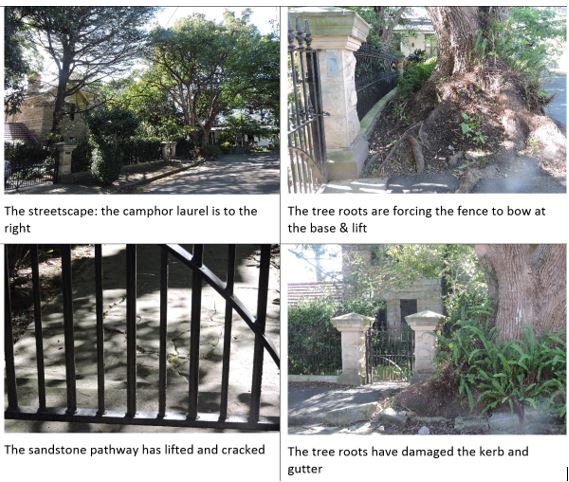
Large tree roots from a mature 90 to 100 years old camphor laurel tree growing in Futuna Street, Hunters Hill were causing damage. A large tree root had lifted and bowed the wrought iron front fence, built 30 years previously at a cost of $100,000. Two tripping incidents had occurred on the front path, where flagstones had lifted. The front gate could not be locked due to movement in the piers. See images.
The owner, Dr Donnelly complained to the Council. The Council refused to remove the tree and said the tree was in good health and that the interference caused by the camphor laurel roots was trivial and aesthetic only. The tree was considered to have a medium useful life expectancy of 15 to 40 years. Council added that the principles of give and take and live and let live in a community were more important than the damage to the fence and the path.
The Court found that Council was liable for breach of the tort of private nuisance, because Council’s failure to remove the tree was a substantial and unreasonable interference with the private right to use and enjoy the land, because it was causing damage. The Court findings were:
- The damage was material and substantial. It was not a minor or trifling interference with the owners’ enjoyment of the land.
- Council was aware that the fence would be constructed when it gave approval in 1989 and must be taken to have been aware of the damage caused by the tree roots by the visible damage to the road, kerb and footpath.
- The damage was brought to its attention by the owner in November 2017, yet Council has failed to take reasonable steps to bring the nuisance to an end.
- The damage caused by the encroaching tree roots is reasonably foreseeable and there is a real risk of further significant damage.
The Court ordered the Council pay damages to the owner:
- For the cost of repairing the fence, gate and path - $28,765.33.
- For two expert reports pre-litigation - $1,715.
- For interference with and loss of enjoyment of the land - $5,000.
The Court ordered the tree be removed within four months (at Council’s cost).
The Court ordered the Council pay Dr Donnelly’s legal costs in the proceedings.
The author’s fuller version of this case study is found at this link Court orders the Hunter’s Hill Council to remove a camphor laurel street tree
Other author articles on tree disputes:
Tree Disputes - The right to prune overhanging branches
Tree Disputes - Tree branches and trunks causing damage
Tree disputes - Tree roots causing damage
Tree Disputes - Trees causing injury